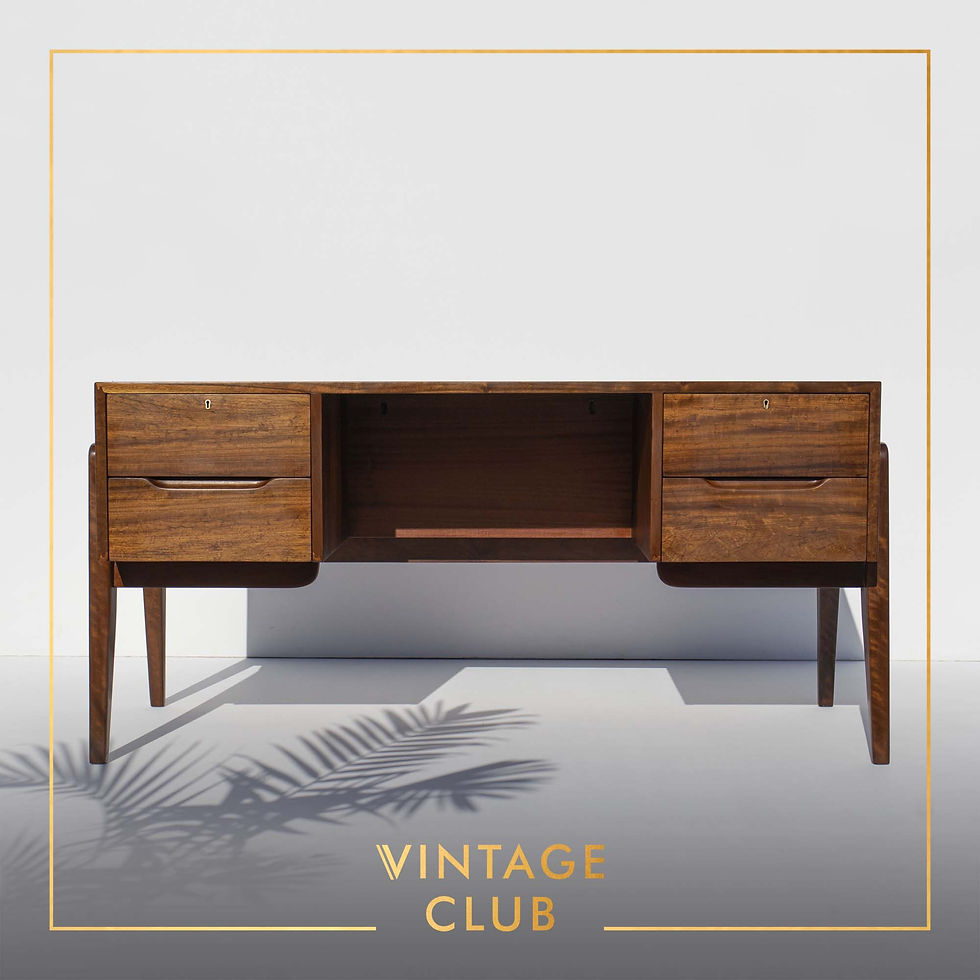
Arne Vodder Danish Teak Freestanding Desk by G.V. Møbler, Denmark, c. 1960s
A Freestanding Danish Modern Desk — Sculptural Precision in Warm Teak
A distinguished example of Danish modernism at its most considered — a freestanding teak desk attributed to Arne Vodder and produced by G.V. Møbler (Gasvig Møbler) during the 1960s, a decade that represents the apex of Scandinavian furniture design.
Made in richly grained teak, the composition is at once architectural and inviting. The floating tabletop, edged with Vodder's characteristic softly rounded profile, sits above an asymmetric storage arrangement: three graduated drawers to one side, a full-height cupboard, each fitted with Vodder's instantly recognisable circular recessed pulls — a sculpted, deeply carved detail that is as tactile as it is decorative, and one of the most distinctive signatures of his cabinetmaking vocabulary.
The structural framing — with its squared, tapering legs running along the full depth of each pedestal — gives the desk a strong, linear presence from every angle. Designed entirely in the round, the fully finished rear allows the piece to stand freely within a room, functioning as a sculptural interior element as naturally as it does a workspace.
A piece of quiet authority, equally suited to a refined home study or as a considered focal point within a living interior.
Designer Profile — Arne Vodder (1926–2009)
Arne Vodder was among the most accomplished and quietly influential figures of the Danish modern movement. Trained as both a cabinetmaker and an architect, he studied under Finn Juhl at the Royal Danish Academy of Fine Arts in Copenhagen — an education that instilled in him the belief that furniture should be resolved as architecture: considered from every angle, honest in material, and restrained in ornament.
In 1950, Vodder established his own studio in partnership with architect Anton Borg, producing a body of work distinguished by its understated precision — organic profiles, beautifully proportioned storage compositions, and the discreet integrated handles that became his hallmark.
He collaborated with prominent Danish manufacturers including Fritz Hansen, France & Søn, Sibast, and G.V. Møbler, and his furniture was selected for some of the most prestigious interiors of the postwar era — among them diplomatic residences associated with President Jimmy Carter and President Anwar Sadat, as well as the United Nations Office in Geneva.
Today, Vodder's work is increasingly sought after by collectors and institutions for its quiet sophistication, exceptional craftsmanship, and enduring relevance.
Read more here